https://ascensi.ro/en/insights/the-ai-act-compliance-line
Boardroom Strategy
The AI Act Is Live. The Compliance Line Your Budget Is Missing.
The EU's AI rulebook has applied since 2 August 2026. On 2 December 2027 its high-risk rules reach the HR tools adopted before anyone called them regulated.

Ascensi Management · 9 min read
The briefFor CFOs9 min read
- Any company that uses AI in employment decisions counts as a deployer under the Act, and the obligations attach to that use.
- HR is where AI entered most companies first — a CV screener here, a video-interview scorer there, a chatbot answering leave requests somewhere else.
- One “yes” on hiring or evaluation software makes the company a deployer of a high-risk employment system, with the oversight duties that follow.
On this page
The AI Act is not a problem for technology companies. It is a governance deadline for every company whose HR systems screen, score, or assign work to people — and the budget line for it is missing in most board plans.
Since 2 August 2026, the AI Act applies across the EU, and its rules for the high-risk systems of Annex III, hiring and HR among them, apply from 2 December 2027 (official regulation page; Article 113, as amended by Regulation (EU) 2026/1744). In our client work, most executives first describe it as a problem for software vendors — the companies that build AI. The regulation takes the opposite view: any company that uses AI in employment decisions counts as a deployer under the Act, and the obligations attach to that use.
And HR is where AI entered most companies first — a CV screener here, a video-interview scorer there, a chatbot answering leave requests somewhere else. None of it was bought as “regulated software”. Most of it, in the eyes of the regulation, is high-risk: Annex III, point 4 lists AI used to recruit and select people, filter applications, evaluate candidates, allocate tasks and monitor or evaluate performance (Digi24). The chatbot is the exception: the Act asks that people know they are talking to an AI system (Article 50).
What changed on 2 August 2026
Three properties make the AI Act different from the directives most companies are used to. It applies directly — no national transposition law to wait for, so each rule binds companies on the day it becomes applicable (Aleph Business). It reaches beyond the EU's borders — companies outside the Union fall under it if the output of their systems is used in the EU (Article 2). And it regulates uses, not products: the same general-purpose model can be unregulated in one context and high-risk in another, and employment is on the high-risk side of that line.
The use cases are spelled out rather than implied — filtering applications, evaluating candidates, deciding on promotion or termination, allocating tasks, monitoring and evaluating performance (Annex III, point 4). The Act treats those systems as high-risk, unless one only performs a narrow procedural or preparatory task and profiles no one (Article 6), and it splits the duties. The vendor, as provider, owes risk management, data governance, technical documentation and a design that allows human oversight (Articles 9 to 16). The company, as deployer, owes its own: use the system as instructed, give oversight to people with the competence and authority to exercise it, keep its logs for at least six months, tell workers' representatives and the workers affected before the system is used at work, and tell the people it decides about (Article 26; Juridice.ro analysis). “We only bought the tool” is not a defense — as deployer, those duties are the company's own.
“If you use ChatGPT to screen CVs … you are already covered.”
Marius Stanciu, Partner, Buju, Stanciu și Asociații
Translated from the original
Source: financiarul.ro
One boundary we hold: this is an operational reading of a legal text, not legal advice. Dates and obligations should be checked against the consolidated regulation and your own counsel before you act. We write about the workforce-planning side of it, not the courtroom side.
Are you in scope? Three questions
- Do we use software to screen, filter, or rank candidates or CVs?
- Do we use algorithms to monitor or evaluate performance and behaviour, allocate tasks, or decide on promotion or termination?
- Does any chatbot or automated system answer employees — about leave, pay, or policies?
A “yes” to either of the first two is enough to make the company a deployer of a high-risk employment system, with the oversight and information duties that follow from 2 December 2027; a “yes” to the third brings the Act's transparency rule for chatbots (Articles 26 and 50). The uncomfortable detail for mid-sized companies: the tools that trigger this are rarely bought from an AI vendor at all. Screening modules come bundled with recruitment platforms; evaluation features arrive inside HR suites; chatbots get added to an intranet. Each one entered the company through a different door, and no single person owns the register of all of them.
| The deployer's duty (Article 26) | What it looks like inside an HR team |
|---|---|
| Use as instructed | Each system used the way its provider's instructions say — and a register showing which instructions apply to which tool. |
| Human oversight | A named human with the competence, training and authority to override or stop the system. |
| Input data | Where the company controls what feeds the system, data that is relevant and representative for the job it does. |
| Monitoring and logs | Someone watching how the system behaves, suspending it if it puts people at risk, and its logs kept for at least six months — the paper trail an authority can ask for. |
| Informing people | Workers' representatives and the workers affected told before the system is used at work; candidates and employees told when it is used to decide about them — not a disclosure buried in a policy PDF. |
Where the exposure actually sits
5.21%
have adopted AI
of Romanian companies use advanced AI in operations today — one of the lowest rates in CEE
Source: CEE AI Index 2026, via start-up.ro · 8 Jun 2026
31%
cite strategy gap
of Romanian CEOs, CFOs and COOs name “no clear AI integration strategy” as their biggest obstacle — ahead of infrastructure
Source: Revolut Business survey, via Economica.net · 5 Feb 2026
21%
cite change management
name employee change programs among their top-three obstacles — the human side of the compliance question
Source: Revolut Business survey, via Economica.net · 5 Feb 2026
2 Dec 2027 — the date to plan for: when the high-risk rules for hiring and HR systems apply. The Act itself has applied since 2 August 2026, so the window to prepare is open, not approaching (AI Act, Article 113, as amended by Regulation (EU) 2026/1744).
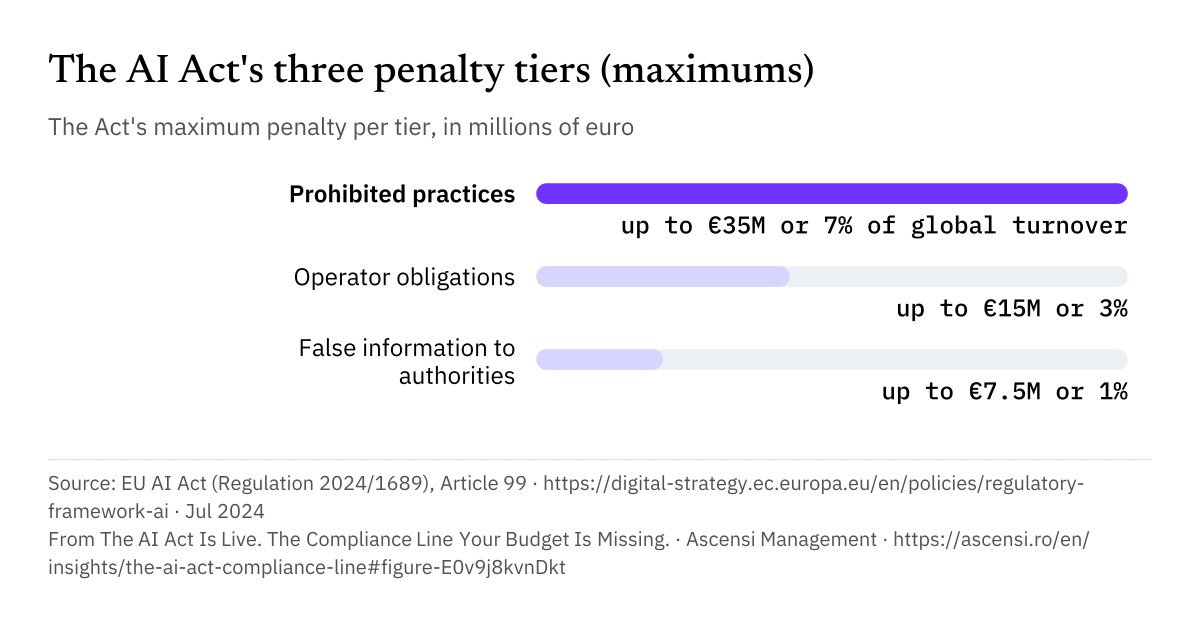
The Act's penalties are structured in tiers rather than a single headline number — and the top tier is deliberately uncomfortable. A company faces whichever is higher, the amount or the share of turnover; an SME, whichever is lower (AI Act, Article 99; Financiarul).
The AI Act's three penalty tiers (maximums)
The Act's maximum penalty per tier, in millions of euro
| Item | Value (€M) |
|---|---|
| Prohibited practices | 35 |
| Operator obligations | 15 |
| False information to authorities | 7.5 |
Source: EU AI Act (Regulation 2024/1689), Article 99 · Jul 2024
Use this figure
Cite
APA
Ascensi Management. (2026). The AI Act's three penalty tiers (maximums) [Figure]. In The AI Act Is Live. The Compliance Line Your Budget Is Missing. https://ascensi.ro/en/insights/the-ai-act-compliance-line#figure-E0v9j8kvnDkt Data: EU AI Act (Regulation 2024/1689), Article 99, Jul 2024.
Chicago
Ascensi Management. “The AI Act's three penalty tiers (maximums).” In The AI Act Is Live. The Compliance Line Your Budget Is Missing., 2026. https://ascensi.ro/en/insights/the-ai-act-compliance-line#figure-E0v9j8kvnDkt. Data: EU AI Act (Regulation 2024/1689), Article 99, Jul 2024.
Link to this figure
https://ascensi.ro/en/insights/the-ai-act-compliance-line#figure-E0v9j8kvnDkt
Download
Embed
<iframe src="https://ascensi.ro/embed/figure/post-the-ai-act-compliance-line-E0v9j8kvnDkt" title="The AI Act's three penalty tiers (maximums)" width="640" height="420" loading="lazy"></iframe>
Insight
Romania has one of the EU's lowest AI adoption rates and one of its highest rates of “no AI strategy” answers — and the Act covers use, not ambition. A company does not need an AI roadmap to be in scope; it only needs one CV-screening feature switched on. That is why the exposure is concentrated exactly where adoption stalled: the tools arrived through procurement before the policies arrived through management.
The comfortable excuse is old and predictable: “it was only a supporting tool”. Romanian technology lawyers hear it often and reject it on the same grounds each time — where a system influences decisions about people, the paperwork obligations follow the decision, not the vendor (Juridice.ro; Digi24). A pilot is not a defense either. Once the high-risk rules apply, a pilot that runs for four months on real applications runs on real people.
The budget line — what to fund now
Most of the work is documentation over people decisions you are making anyway: hiring, evaluating, scheduling. Outside counsel can review it; your own teams have to build it.
- An AI-use inventory. One register of every tool that touches people data — HR, operations, marketing — with an owner for each. This single page is the difference between managing the exposure and discovering it.
- Documentation and assessments. Purpose, data, risk checks, test results. Template it once; reuse it per system. This is the layer authorities and enterprise customers ask to see first.
- Oversight design. For each system: who can override it, how they are told to, and how workers are informed. Oversight that exists only in the vendor's manual does not exist.
- Training that makes oversight real. A manager who cannot read a scoring output cannot oversee it. Change management, the obstacle 21% of executives already name, is what converts a policy into a control.
| Topic | What most companies have | What compliance-grade looks like |
|---|---|---|
| AI policy | An AI policy PDF nobody has read | A one-page register of people-facing AI tools — with a name next to each |
| Risk check | Trust in the vendor's compliance sheet | The company's own documented risk check for each use |
| Oversight | Oversight as a checkbox in procurement | A named override person per system, with instructions workers understand |
| Training | Training “when we get around to it” | Role-specific sessions, tied to the systems actually in use |
The bottom line
The companies that moved into AI in HR first are now in scope first, because in every technology wave use arrives before governance. The advantage from here belongs to whoever can produce the documentation, the oversight, and the policy before a customer, an auditor, or a works council asks for them.
Our HR Strategy Advisory covers the workforce side: mapping where people decisions are already algorithmic, and building the registers, checks and manager capability that make those decisions defensible. The legal reading stays with your counsel.
Cite this article
Ascensi Management (9 Oct 2026). The AI Act Is Live. The Compliance Line Your Budget Is Missing. Ascensi Management Insights. https://ascensi.ro/en/insights/the-ai-act-compliance-line
Cite this article with this credit; for a figure, credit the source shown under it.
Sources
- EU AI Act — official European Commission page, European Commission, Aug 2026
- Regulation (EU) 2024/1689 (AI Act), Official Journal text, EUR-Lex, Jul 2024
- Regulation (EU) 2026/1744 (Digital Omnibus on AI), in force since 27 July 2026, AI Act Explorer, Jul 2026
- Digi24 — “Din august 2026, AI Act devine pe deplin aplicabil în UE. Ce trebuie să știe firmele din România”, Digi24, Apr 2026
- Digi24 — “AI Act schimbă regulile pentru companii. Avocat: clasificarea sistemelor AI în funcție de risc”, Digi24, Apr 2026
- Financiarul — “AI Act aduce amenzi de 35 milioane euro firmelor din România din 2026”, Financiarul, Apr 2026
- Aleph Business — Marius Stanciu, Buju, Stanciu și Asociații interview, Aleph Business, 10 Apr 2026
- Juridice.ro — Victor Buju, “Când algoritmul selectează candidatul: obligațiile operatorului HR sub regimul sistemelor cu risc înalt”, Juridice.ro, Apr 2026
- start-up.ro — CEE AI Index 2026: Romania's 5.21% enterprise AI adoption, start-up.ro, 8 Jun 2026
- ZF English — “Romania Ranks 7th In CEE AI Index 2026”, ZF English, 6 Aug 2026
- Economica.net — “Companiile românești pun pe primul loc investițiile în sisteme IT de bază, mai puțin în soluțiile IA” (Revolut Business study), Economica.net, 5 Feb 2026
- Forbes.ro — “Studiu Revolut Business: Companiile românești prioritizează modernizarea IT, nu inteligența artificială”, Forbes.ro, 5 Feb 2026
Related service
HR Strategy Advisory
Growth hides its own cost until it starts to bite. Organizational Diagnosis, Role-to-Value Alignment, Talent Mapping and Talent Assessment, joined into one diagnosis of what your organization is losing, with the fixes ranked by what they are worth and how seamlessly they can be implemented.
Related articles
 Boardroom StrategyArticle
Pivoting HR from Cost Center to Profit Engine
6 min read · 11 May 2026 Available in English and Romanian
 Culture EconomicsArticle
The Pay-Rise Trap: 83% plan raises, only 34% expect growth
7 min read · 9 Oct 2026 Available in English and Romanian
 Talent EconomicsArticle
Turnover Never Appears on the P&L. That Is Why It Costs So Much.
5 min read · 9 Oct 2026 Available in English and Romanian
Newsletter