https://ascensi.ro/en/insights/the-pay-rise-trap
Culture Economics
The Pay-Rise Trap: 83% plan raises, only 34% expect growth
Most Romanian employers will raise pay in 2026, yet only a third expect revenue to grow. A uniform raise buys calm and misses the second reason people quit.

Ascensi Management · 7 min read
The briefFor CEOs7 min read
- Check first whether you pay below market. If you do, raise pay; if you do not, a uniform raise buys a quiet year, not retention.
- Lack of advancement is the second reason people leave, for employers and employees alike. Fund visible progression in the teams that lose people.
- Price one resignation at half to twice a salary, then set that cost against a manager and progression budget for the same team.
On this page
Keep pay at market, and repair it where it is below. Stop paying the margin above market to everyone at the same rate: spend it on progression and workload in the teams people leave, and measure who stays.
Two numbers moving in opposite directions
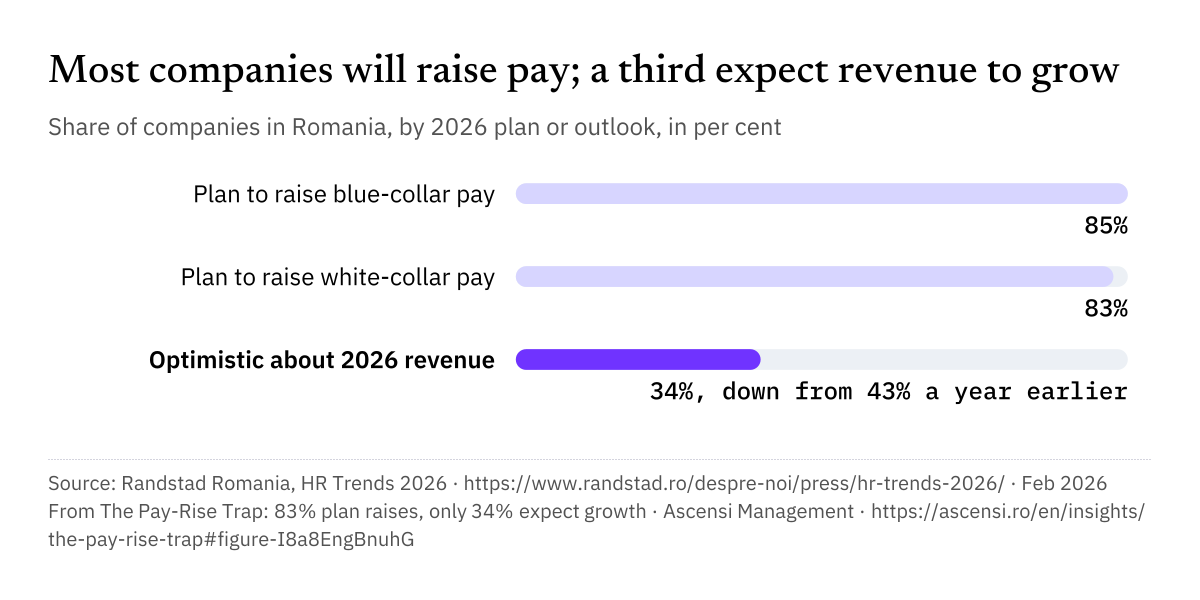
Romania is heading into another raise season. In HR Trends 2026, a survey of more than 217 business leaders run from October to December 2025, 83% of companies said they intend to raise white-collar pay in 2026, and 85% blue-collar pay. In the same survey, the share of companies optimistic about their revenue fell from 43% a year earlier to 34%.
Put the two answers side by side and the raise changes character. When most companies expect revenue to grow, a raise is a share of that growth. When only a third do, it is a fixed cost paid in advance, to keep the company stable for one more year.
83%
Plan raises
Companies in Romania that intend to raise white-collar pay in 2026 (85% for blue-collar staff).
Source: Randstad Romania, HR Trends 2026 · Feb 2026
34%
Expect growth
Companies in Romania optimistic about their 2026 revenue, down from 43% a year earlier.
Source: Randstad Romania, HR Trends 2026 · Feb 2026
28%
Plan to move
Employees in Romania who intend to change jobs in the first half of 2026.
Source: Randstad Romania, Employer Brand Research 2026 · May 2026
Most companies will raise pay; a third expect revenue to grow
Share of companies in Romania, by 2026 plan or outlook, in per cent
| Item | Value (%) |
|---|---|
| Plan to raise blue-collar pay | 85 |
| Plan to raise white-collar pay | 83 |
| Optimistic about 2026 revenue | 34 |
Source: Randstad Romania, HR Trends 2026 · Feb 2026
Use this figure
Cite
APA
Ascensi Management. (2026). Most companies will raise pay; a third expect revenue to grow [Figure]. In The Pay-Rise Trap: 83% plan raises, only 34% expect growth. https://ascensi.ro/en/insights/the-pay-rise-trap#figure-I8a8EngBnuhG Data: Randstad Romania, HR Trends 2026, Feb 2026.
Chicago
Ascensi Management. “Most companies will raise pay; a third expect revenue to grow.” In The Pay-Rise Trap: 83% plan raises, only 34% expect growth, 2026. https://ascensi.ro/en/insights/the-pay-rise-trap#figure-I8a8EngBnuhG. Data: Randstad Romania, HR Trends 2026, Feb 2026.
Link to this figure
https://ascensi.ro/en/insights/the-pay-rise-trap#figure-I8a8EngBnuhG
Download
Embed
<iframe src="https://ascensi.ro/embed/figure/post-the-pay-rise-trap-I8a8EngBnuhG" title="Most companies will raise pay; a third expect revenue to grow" width="640" height="420" loading="lazy"></iframe>
About this data
A survey of more than 217 business leaders in Romania, October to December 2025. The raise figures are intentions, not payroll data, so treat them as planning inputs.
The exit causes a uniform raise does not reach
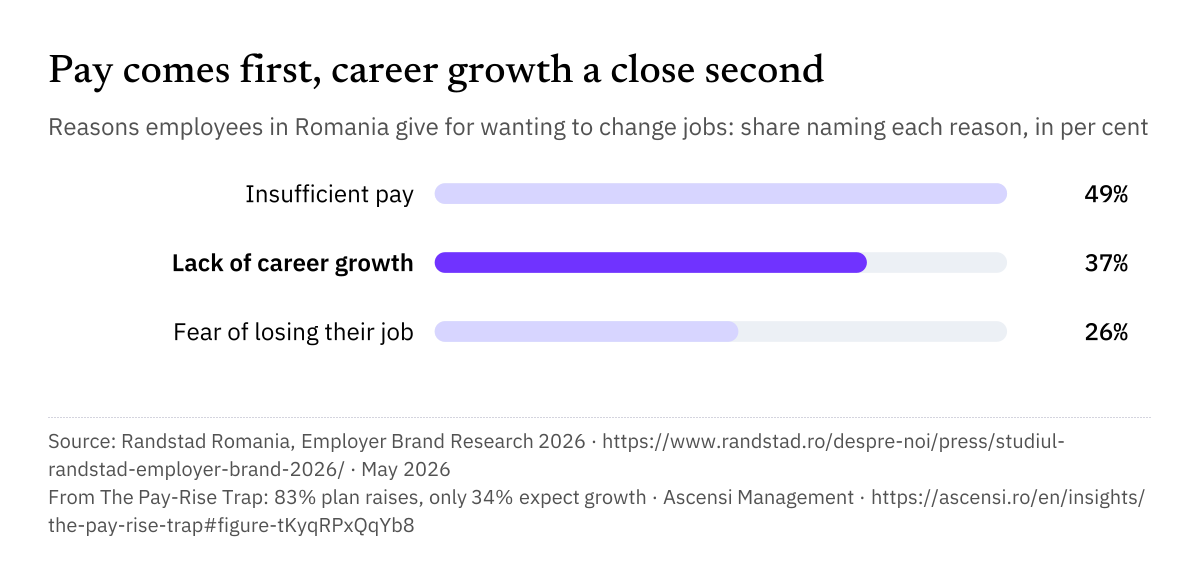
Pay is the first reason people leave, and the data says so plainly. In HR Trends 2026, salary remains the main driver of staff turnover, at 79%. In the Employer Brand Research 2026, a survey of 4,030 working Romanians in January 2026, insufficient pay is the most common reason for wanting to leave, at 49%.
The second reason is the same on both sides of the table. Employers attribute 39% of departures to a lack of advancement. Among the reasons employees give for wanting to leave, a lack of career growth stands at 37%. A raise applied to everyone at the same rate changes neither figure: a person who sees no next step still sees none after the raise.
Two further causes sit outside pay. HR Trends 2026 reports that 28% of employees resign over excessive workload. And 26% of the employees in the Employer Brand Research give fear of losing their job as a reason to look elsewhere, a worry that a raise does little to settle.
Pay comes first, career growth a close second
Reasons employees in Romania give for wanting to change jobs: share naming each reason, in per cent
| Item | Value (%) |
|---|---|
| Insufficient pay | 49 |
| Lack of career growth | 37 |
| Fear of losing their job | 26 |
Source: Randstad Romania, Employer Brand Research 2026 · May 2026
Use this figure
Cite
APA
Ascensi Management. (2026). Pay comes first, career growth a close second [Figure]. In The Pay-Rise Trap: 83% plan raises, only 34% expect growth. https://ascensi.ro/en/insights/the-pay-rise-trap#figure-tKyqRPxQqYb8 Data: Randstad Romania, Employer Brand Research 2026, May 2026.
Chicago
Ascensi Management. “Pay comes first, career growth a close second.” In The Pay-Rise Trap: 83% plan raises, only 34% expect growth, 2026. https://ascensi.ro/en/insights/the-pay-rise-trap#figure-tKyqRPxQqYb8. Data: Randstad Romania, Employer Brand Research 2026, May 2026.
Link to this figure
https://ascensi.ro/en/insights/the-pay-rise-trap#figure-tKyqRPxQqYb8
Download
Embed
<iframe src="https://ascensi.ro/embed/figure/post-the-pay-rise-trap-tKyqRPxQqYb8" title="Pay comes first, career growth a close second" width="640" height="420" loading="lazy"></iframe>
About this data
An online survey of 4,030 people in Romania's working population, January 2026. The shares add up to more than 100, so respondents could name more than one reason.
HR Trends 2026 gives two figures for the same cause: 28% of employees resign over excessive workload in one passage and 29% in another, in the same release. We show both and do not pick one.
Insight
Two surveys, run on opposite sides of the table, land two points apart on the second exit cause: employers attribute 39% of departures to a lack of advancement, and employees give a lack of career growth as a reason for wanting to leave at 37%. Neither survey was designed to confirm the other, and they measure slightly different things, so the closeness matters more than the exact figures. Read together, they suggest that once pay is at market, retention money does more in progression than in a larger uniform raise.
When the raise is the right call
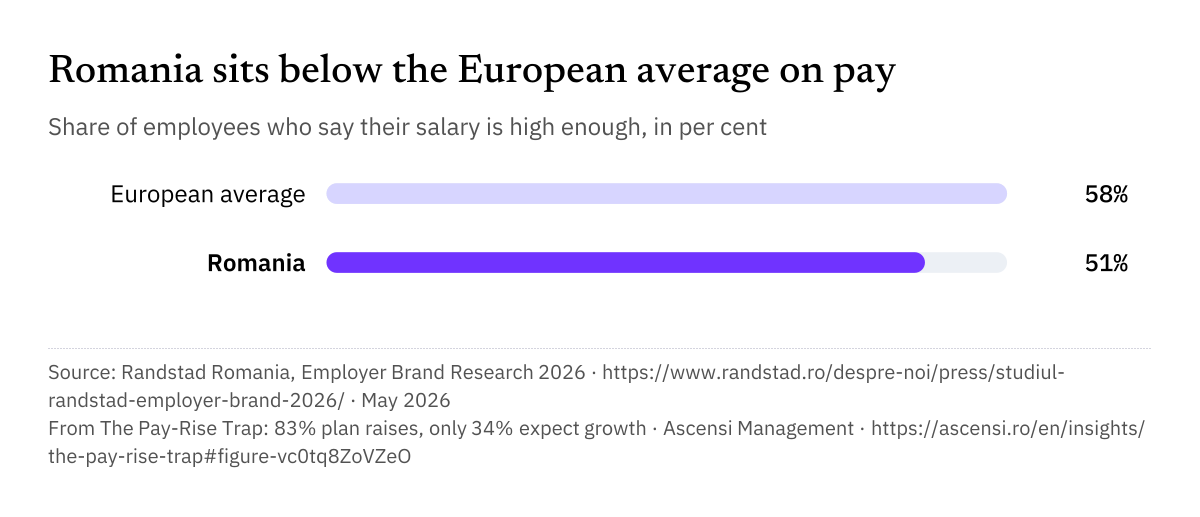
None of this argues for freezing pay. For 67% of Romanians, salary is the main reason to choose an employer: 64% among Generation Z and 71% among people with longer careers. Only 51% say their pay is high enough, against a European average of 58%. And 23% of the employers in HR Trends 2026 admit they pay below the market for similar roles.
If your company is in that 23%, the raise is a repair, and it should come first. The trap is narrower: the part of the budget above market, paid to everyone at the same rate, to defend against no particular risk.
Romania sits below the European average on pay
Share of employees who say their salary is high enough, in per cent
| Item | Value (%) |
|---|---|
| European average | 58 |
| Romania | 51 |
Source: Randstad Romania, Employer Brand Research 2026 · May 2026
Use this figure
Cite
APA
Ascensi Management. (2026). Romania sits below the European average on pay [Figure]. In The Pay-Rise Trap: 83% plan raises, only 34% expect growth. https://ascensi.ro/en/insights/the-pay-rise-trap#figure-vc0tq8ZoVZeO Data: Randstad Romania, Employer Brand Research 2026, May 2026.
Chicago
Ascensi Management. “Romania sits below the European average on pay.” In The Pay-Rise Trap: 83% plan raises, only 34% expect growth, 2026. https://ascensi.ro/en/insights/the-pay-rise-trap#figure-vc0tq8ZoVZeO. Data: Randstad Romania, Employer Brand Research 2026, May 2026.
Link to this figure
https://ascensi.ro/en/insights/the-pay-rise-trap#figure-vc0tq8ZoVZeO
Download
Embed
<iframe src="https://ascensi.ro/embed/figure/post-the-pay-rise-trap-vc0tq8ZoVZeO" title="Romania sits below the European average on pay" width="640" height="420" loading="lazy"></iframe>
Why the trap works on good managers
The raise is popular inside a company for the same reasons it is expensive: it looks fair, everyone sees it, and it lands at once. Nobody has to argue about who matters more. It buys a calm year, and calm is attractive in a year when only a third of companies expect revenue to grow.
What it replaces is the harder spending: training managers to run their teams well, and building progression that people can see. Both take months, both are hard to schedule, and both lose the budget discussion to a raise unless someone prices the alternative.
At a roundtable of employers in Brașov in September 2026, Aurelia Florea of Miele Tehnica România described what kept people at her company:
“Not everything can be granted, but if every year we took account of them and put in place two or three of the measures they wanted, that made them stay with us and see Miele as an ‘employer of choice, not an employer of cash’. Being a preferred employer means you want to stay and to feel good, not just because you get a salary and have a bank loan to pay.”
Aurelia Florea, Director Organizational Development & People Experience, Miele Tehnica România
Translated from the original
Source: revistacariere.ro
Paying at market stops the exits about money. It does nothing for the exits about going nowhere.
The reallocation: a trade, not a cut
Matching the market is the minimum. The trade happens at the margin: the part of the raise budget that would have gone to everyone at the same rate moves to the three causes that decide whether people stay.
Manager capability
Managers decide most of what an employee experiences as workload and as a next step. Train them to set priorities and to talk about progression.
Visible progression
Lack of advancement is the second exit cause on both sides of the table. Show career paths, internal moves and stretch assignments, with dates.
Workload in the teams that lose people
If 28% of resignations start with workload, the fix is an operations decision. Start in the one or two teams where exits cluster.
The arithmetic a CFO can run this quarter: price one avoided resignation at one-half to two times the employee's annual salary, the range Gallup gives for replacing one employee, and compare it with the manager-training and progression budget for the team that person would have left. The range is a US estimate from 2019, so treat it as directional for Romania.
Price your turnover at your own numbers
Enter your own figures. The result is what one year of staff turnover costs at the replacement range above, before any raise. The defaults are illustrative only.
Calculator
Cost of staff turnover
An estimate from your inputs: a range, not a forecast.
Your input stays on this page. It is not stored anywhere else.
Checklist
Signs your raise budget is doing the work of retention
The bottom line
Raising salaries is not the mistake. The mistake is letting the raise become the whole retention plan at a company that already suspects it is not working, so that it wins the budget every year against measures that would. The companies that get out of this loop do not cut raises. They show on one page what the raise buys and what the alternative buys, and let the arithmetic decide.
Our HR Strategy Advisory builds that page with you: the raise budget set against the cost of turnover, the capability of your managers, and progression paths for the teams you are losing people from.
Cite this article
Ascensi Management (9 Oct 2026). The Pay-Rise Trap: 83% plan raises, only 34% expect growth. Ascensi Management Insights. https://ascensi.ro/en/insights/the-pay-rise-trap
Cite this article with this credit; for a figure, credit the source shown under it.
Sources
- HR Trends 2026 (in Romanian), Randstad Romania, 6 Feb 2026
- 85% dintre angajatori planifică măriri salariale în 2026 (in Romanian), Wall-Street.ro, 6 Feb 2026
- Employer Brand Research 2026 (in Romanian), Randstad Romania, 6 May 2026
- Ce cred românii despre salariul pe care îl câștigă (in Romanian), Economica.net, 7 May 2026
- CEO + HR Roundtable Brașov: Salariul contează, dar pentru a-i face pe oameni să rămână e nevoie de mai mult (in Romanian), Revista Cariere, 15 Sep 2026
- The cost of replacing an employee, by Shane McFeely and Ben Wigert, Gallup, 13 Mar 2019
Related service
HR Strategy Advisory
Growth hides its own cost until it starts to bite. Organizational Diagnosis, Role-to-Value Alignment, Talent Mapping and Talent Assessment, joined into one diagnosis of what your organization is losing, with the fixes ranked by what they are worth and how seamlessly they can be implemented.
Related articles
 Culture EconomicsArticle
The Engagement Paradox: One of Europe's Most Engaged Workforces Still Quits
7 min read · 25 Sep 2026 Available in English and Romanian
 Culture EconomicsArticle
Is Your Culture an Asset or a Liability on Your Balance Sheet?
10 min read · 11 Sep 2026 Available in English and Romanian
 Talent EconomicsArticle
Turnover Never Appears on the P&L. That Is Why It Costs So Much.
5 min read · 9 Oct 2026 Available in English and Romanian
Newsletter