https://ascensi.ro/en/insights/is-your-culture-an-asset-or-a-liability-on-your-balance-sheet
Culture Economics
Is Your Culture an Asset or a Liability on Your Balance Sheet?
Two cost centers start compounding: the mis-hires you keep making, and the managers you promoted but never trained. Neither shows up as a line on the P&L.

Ascensi Management · 10 min read
The briefFor CEOs10 min read
- Price one mis-hire at your own salaries: 100–150% for a middle manager, up to 213% at C-level.
- Check who trains a new manager before promotion; most companies check nobody.
- Romania's high engagement rules out morale; look at managers and hiring first.
On this page
Culture and management quality aren't soft metrics. They're either compounding assets that lower your cost of growth, or quiet liabilities that erode margin every quarter you don't measure them.
Every CEO scaling a growing company hits the same wall, even if no one names it in the boardroom: communication that used to happen in a hallway now takes three meetings, your best people go quiet instead of vocal, and the "bad hire" you made in Q2 is still costing you in Q4. None of these show up as a discrete line item. All of them show up in your margin.
The invisible tax of growth
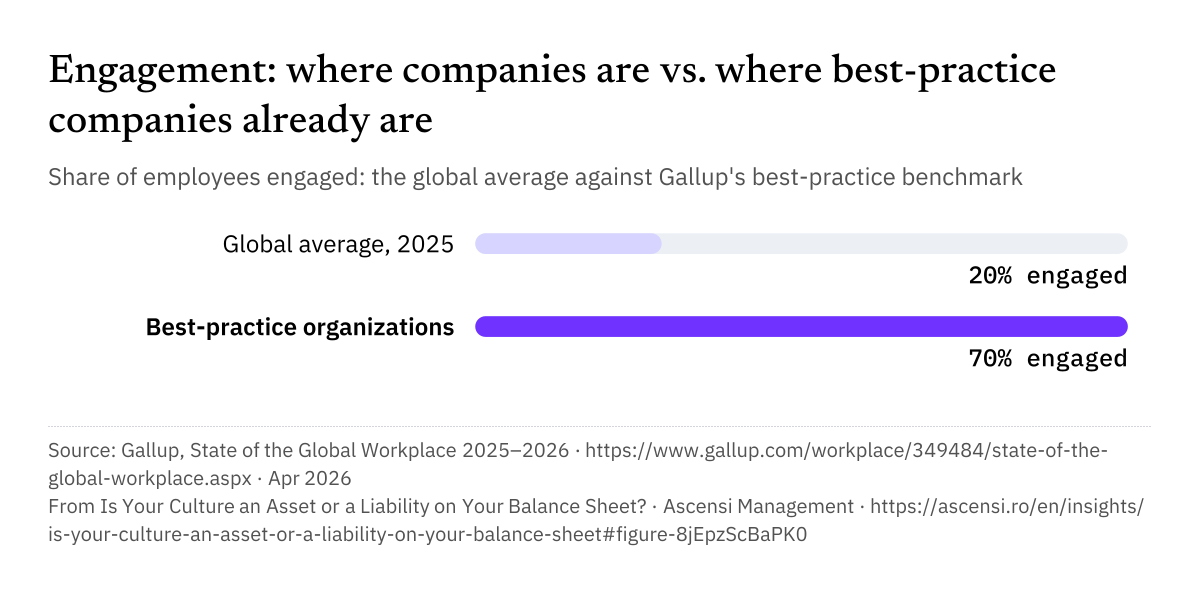
Employee engagement is the closest thing HR research has to a single proxy for "is this organization running well". Gallup's latest global tracking puts only 20% of employees worldwide as engaged in 2025 — the lowest level since 2020 — costing the global economy an estimated $10 trillion in lost productivity, roughly 9% of global GDP.
Gallup's own data shows the steepest driver was manager engagement, which fell five points — from 27% to 22% — between 2024 and 2025 alone, the sharpest single-year drop the study has recorded. When the people running your teams disengage, their teams follow. In the same study, Europe sits at 12%, below the global 20%.
Engagement: where companies are vs. where best-practice companies already are
Share of employees engaged: the global average against Gallup's best-practice benchmark
| Item | Value (%) |
|---|---|
| Global average, 2025 | 20 |
| Best-practice organizations | 70 |
Source: Gallup, State of the Global Workplace 2025–2026 · Apr 2026
Use this figure
Cite
APA
Ascensi Management. (2026). Engagement: where companies are vs. where best-practice companies already are [Figure]. In Is Your Culture an Asset or a Liability on Your Balance Sheet? https://ascensi.ro/en/insights/is-your-culture-an-asset-or-a-liability-on-your-balance-sheet#figure-8jEpzScBaPK0 Data: Gallup, State of the Global Workplace 2025–2026, Apr 2026.
Chicago
Ascensi Management. “Engagement: where companies are vs. where best-practice companies already are.” In Is Your Culture an Asset or a Liability on Your Balance Sheet?, 2026. https://ascensi.ro/en/insights/is-your-culture-an-asset-or-a-liability-on-your-balance-sheet#figure-8jEpzScBaPK0. Data: Gallup, State of the Global Workplace 2025–2026, Apr 2026.
Link to this figure
https://ascensi.ro/en/insights/is-your-culture-an-asset-or-a-liability-on-your-balance-sheet#figure-8jEpzScBaPK0
Download
Embed
<iframe src="https://ascensi.ro/embed/figure/7ae7daaa-76d7-4a3f-bf46-11bbc8345f0a-8jEpzScBaPK0" title="Engagement: where companies are vs. where best-practice companies already are" width="640" height="420" loading="lazy"></iframe>
Insight
The overall engagement number and the manager-specific number measure the same problem twice. Engagement fell hardest at exactly the layer that determines whether everyone below them stays engaged. That is the thread through both problems below: mis-hires and undertrained managers are one structural gap, showing up at two points in the org chart.
Headache #1 — the cost of mis-hires
A "bad hire" is never priced at the salary you paid them. It's priced at the salary, plus the recruiting cost, plus the onboarding time, plus the manager-hours spent managing them out, plus what their team didn't do while all of that was happening.
- At the middle-management level, a bad hire is estimated to cost 100–150% of annual salary (Source: SHRM).
- At the C-suite level, that estimate rises to up to 200–213% of annual salary (Source: MyCulture).
- Independently, Gallup's research on disengaged teams (which is where most mis-hires end up if they aren't removed quickly) finds turnover running 21–51% lower in engaged teams than in disengaged ones, and engaged business units outperforming disengaged ones by 23% in profitability.
For a company at your scale, one mis-hired department head is a figure that belongs on the CFO's risk register, not something buried in a "recruitment fees" line. Romanian replacement-cost data lands in the same band; we chart the two side by side, by seniority, in Turnover Never Appears on the P&L.
Headache #2 — the management gap
The second headache is upstream of the first: most department heads were never taught to manage. They were promoted because they were the best individual performer, then handed a team with zero preparation for the actual job of managing people.
82%
have no training
of new UK managers receive no formal training before taking on the role
Source: CMI with YouGov · Oct 2023
29%
declining trust
29% of employees globally say they trust their immediate manager — a 37% relative decline since 2022
Source: DDI, Global Leadership Forecast 2025 · Jan 2025
71%
higher stress
of leaders report significantly higher stress since stepping into their management role
Source: DDI, Global Leadership Forecast 2025 · Jan 2025
19%
ready to delegate
of newly promoted leaders have the delegation skills needed to actually operate as managers
Source: DDI, Global Leadership Forecast 2025 · Jan 2025
This is the mechanism behind "turning your department heads into high-performance mentors": closing a documented, measured skills gap that most companies never diagnose, because the manager in question is still hitting their own individual targets.
Romania: high engagement, hard hiring
Romania does not fit the global picture: Gallup puts its engagement at 31%, second in Europe after Albania, while private-sector turnover has run around 20% a year (AmCham Romania, a 2022 benchmark), about double the European norm. We take that paradox apart in The Engagement Paradox; it points at the same two mechanisms as this article, untrained managers and a hiring bar that slips.
- Romania faces a structural labor deficit estimated at over 600,000 workers, with a job-vacancy rate that stayed low (0.7% in 2024) even as employers report they still can't fill roles — a sign the shortage is about matching skills to open roles, not headcount alone.
- In PwC's CEE CEO Survey, over 40% of CEE CEOs cite lack of workforce skills as a significant internal barrier to transformation — on par with limited financial resources.
- eJobs' own 2026 employer survey found 20.2% of Romanian companies froze hiring entirely and a further 18.3% cut recruitment by 10–25%, citing domestic political instability and rising operating costs — exactly the growth-under-pressure conditions where hiring bars quietly slip.
Bogdan Badea, CEO of eJobs, Romania's largest online recruitment platform, told ZF Live, Ziarul Financiar in April 2026 that the Romanian labor market is going through its toughest stretch for new job postings in a decade: companies are delaying investment and hiring more cautiously, and a lack of private-sector confidence is starting to show up directly in the numbers.
The mistakes we see CEOs repeat in CEE and Romania
These are composite patterns drawn from the regional data above and from what a scaling company's structure typically produces under those conditions — not quotes from a single named study, and not one of our specific clients. Each is labeled with why it happens, because the mistake usually looks rational from inside the pressure that causes it.
Lowering the bar to fill a seat fast
Nearly 40% of Romanian companies froze or cut recruitment in 2026 while still needing roles filled — a structural labor deficit doesn't pause just because hiring budgets do. "Good enough, available now" starts to look like the only realistic option.
Promoting the top performer, not the best manager
The best salesperson becomes Head of Sales overnight, with no formal training: in the UK, 82% of new managers get none (CMI with YouGov, Oct 2023).
Treating HR as the first budget line to cut
When macro pressure hits — and Romanian employers cite exactly this in 2026 surveys, from political instability to rising operating costs — hiring freezes and HR headcount are usually first to go.
No cost-of-turnover number anyone can point to
Most companies at this scale can tell you last quarter's revenue to the euro. Very few can tell you what their last five departures actually cost.
Running engagement surveys with no structural follow-through
A survey gets sent, scores come back low, a summary slide gets shown once — and nothing about how people are managed actually changes.
Investing in C-suite coaching, not the middle layer
Leadership development budgets skew toward the top team, while the DDI data shows it's frontline and middle managers who are most stressed and least trusted.
Classic cost-center HR vs. profit-engine HR Strategy Advisory
The difference is what HR is asked to be accountable for.
| Topic | Classic / Admin HR | Our HR Strategy Advisory |
|---|---|---|
| Hiring approach | CV screen + gut-feel interview; speed over fit | Structured profile built from your top performers' actual traits, validated before offer stage |
| Management pipeline | Best performer promoted, given a title and a team | Management readiness assessed and coached before the promotion, not after the damage |
| Culture measurement | Annual engagement survey, filed and forgotten | Ongoing signal tracked against retention and performance, tied to specific management action |
| Cost visibility | Turnover and mis-hire cost untracked; invisible on the P&L | Mis-hire and turnover exposure quantified and reported like any other business risk |
| CEO's role | Approves the HR budget; rarely reviews HR outcomes | Reviews people metrics with the same rigor as revenue and margin |
Where the value actually shows up
Mis-hire prevention
Classic: a bad hire is discovered in month 4, replaced in month 7 — full 150–213% cost realized.
Management capability
Classic: new manager joins the 82% with no training; team disengagement follows within a quarter.
Retention economics
Classic: turnover cost is a felt frustration, not a number — hard to justify budget to fix it.
The bottom line
Scaling a company is a milestone. It's also the point where the invisible tax of growth starts compounding — slower communication, quieter top performers, a mis-hire rate nobody's pricing. At that stage, HR can't stay "admin and payroll". It has to become the function that turns every person on your payroll into an investment.
Our HR Strategy Advisory puts your mis-hire and management-gap cost on one page for the board, and ranks what to fix first.
Cite this article
Ascensi Management (11 Sep 2026). Is Your Culture an Asset or a Liability on Your Balance Sheet? Ascensi Management Insights. https://ascensi.ro/en/insights/is-your-culture-an-asset-or-a-liability-on-your-balance-sheet
Cite this article with this credit; for a figure, credit the source shown under it.
Sources
- Gallup, State of the Global Workplace 2025–2026, Gallup, Apr 2026
- Gallup, Q12 Meta-Analysis, 11th edition: "The Relationship Between Engagement at Work and Organizational Outcomes", Gallup, May 2024
- SHRM, "The Cost of a Bad Hire Can Be Astronomical", SHRM, May 2017
- MyCulture, "Cost of Bad Hire", MyCulture, Mar 2026
- Chartered Management Institute with YouGov — Taking Responsibility – Why UK PLC Needs Better Managers, Chartered Management Institute (CMI) with YouGov, Oct 2023
- DDI, Global Leadership Forecast 2025, DDI, Jan 2025
- Ziarul Financiar (RO), ZF Live interview with Bogdan Badea, CEO of eJobs, Ziarul Financiar, Apr 2026
- Business Review, "Romanian companies' hiring plans affected by lower consumption, political instability and rising costs", Business Review, 17 Jun 2026
- AmCham Romania, Labour Market Analysis, AmCham Romania, Sep 2023
- Euro HR Solutions, "How to Calculate Employee Turnover Rate", Euro HR Solutions, 27 May 2026
- PwC, 27th Annual Global CEO Survey — CEE Edition, PwC, Jan 2024
- BCM Group, "Romania Updated Market Data For Workers", BCM Group, Jan 2026
Related service
HR Strategy Advisory
Growth hides its own cost until it starts to bite. Organizational Diagnosis, Role-to-Value Alignment, Talent Mapping and Talent Assessment, joined into one diagnosis of what your organization is losing, with the fixes ranked by what they are worth and how seamlessly they can be implemented.
Related articles
 Culture EconomicsArticle
The Pay-Rise Trap: 83% plan raises, only 34% expect growth
7 min read · 9 Oct 2026 Available in English and Romanian
 Culture EconomicsArticle
The Engagement Paradox: One of Europe's Most Engaged Workforces Still Quits
7 min read · 25 Sep 2026 Available in English and Romanian
 Talent EconomicsArticle
Turnover Never Appears on the P&L. That Is Why It Costs So Much.
5 min read · 9 Oct 2026 Available in English and Romanian
Newsletter