https://ascensi.ro/en/insights/cases/succession-plan-next-generation
Case study · Boardroom Strategy
Your succession plan looks perfect, but only 51% of the next generation knows it exists
Two family food makers: one lost value at every unplanned handover, one handed over while its founder could still coach. What Romanian owners can learn.

Ascensi Management · 13 min read
The engagement
- Sector
- Family-owned food manufacturing and distribution
- Size
- Mid-size to large, publicly listed
- Market
- Romania and Sri Lanka
- Commissioned by
- Not commissioned: a market case read from public sources
If your successor learns the plan the day you leave, you have no plan. Name the critical roles, assess who is ready, tell them, and hand over while you can still correct the choice.
The benchmark: what a large buyer expects of its suppliers
In November 2020 Marks & Spencer published Systems for Success, a reference guide for the companies that supply its food. Many of those suppliers are family firms. Its talent management chapter grades a supplier on four levels. At the third level it expects a "process to identify workers with potential to progress", and it adds that the process "is well communicated". At the fourth, "'Grow your own' and 'Grow your successor' are embedded" and most roles are filled from inside.
Three lines in that standard carry most of the weight: potential is found by a process rather than by the owner's instinct; the people involved know the process exists; and successors are grown before the seat is empty. The two companies in this case show what happens on each side of those lines.
| Topic | Harischandra Mills, Sri Lanka | Cris-Tim, Romania |
|---|---|---|
| Find potential through a process | No process: the founder put little effort into developing a successor | The sons earned trust before they earned decisions; the company says it works on merit |
| Tell people the process exists | The current managing director has no named successor and no development plan | The handover was public: the son became CEO in 2019 and the founder moved to a strategist role |
| Grow the successor before the seat is empty | Two handovers came with a death, in 1985 and 1989 | The founder handed over while he was still there to advise |
| Separate ownership from management | Non-family chairmen from 1989 onwards; the family's part in running the business shrank over time | A 2025 stock-market listing: the founders keep 65.49%, and 34.48% trades freely |
Harischandra Mills: three handovers and no plan
C. A. Harischandra founded the company in Matara, Sri Lanka, in 1943 as a rice mill. It now makes and distributes noodles, coffee, flours and soaps, has been listed on the Colombo Stock Exchange since 1983, and had 935 employees at the end of 2016. It is in its third generation. A case study published in IJRISS in January 2021 by C. H. Wijayasinghe, written with the managing director's permission, sets 34 years of annual-report figures against the company's leadership changes.
27points
Founder's death year
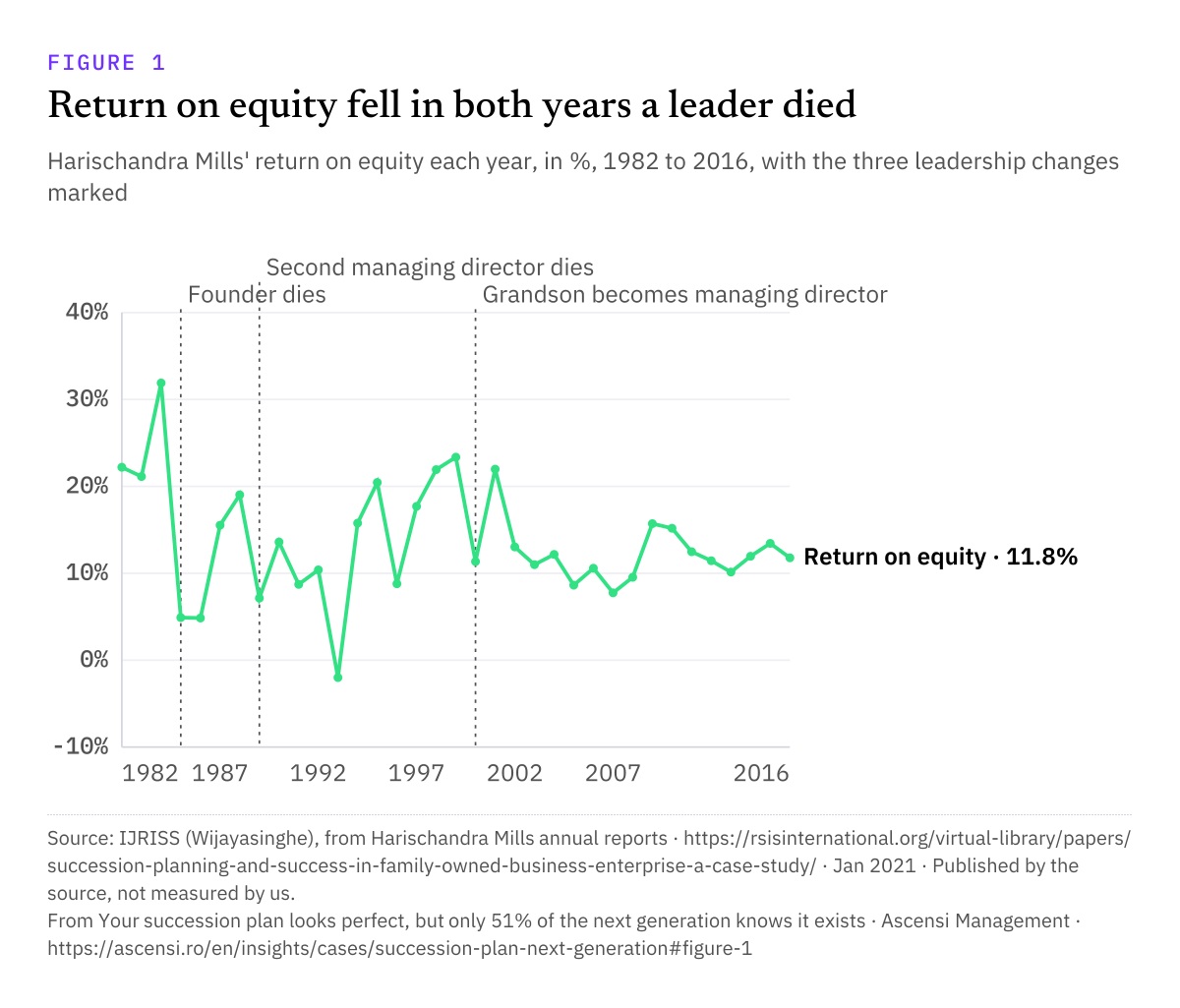
Fall in Harischandra's return on equity from 1984 (31.9%) to 1985, the year the founder died (4.9%).
Source: IJRISS, Wijayasinghe, 2021 · Jan 2021
11.9points
Second leader's death
Fall in return on equity from 1988 (19.03%) to 1989, the year his widow, the second managing director, died (7.14%).
Source: IJRISS, Wijayasinghe, 2021 · Jan 2021
935people
Employees
People employed by Harischandra Mills at the end of 2016.
Source: IJRISS, Wijayasinghe, 2021 · Jan 2021
Figure 1
Return on equity fell in both years a leader died
Harischandra Mills' return on equity each year, in %, 1982 to 2016, with the three leadership changes marked
| Period | Return on equity (%) | Moment |
|---|---|---|
| 1982 | 22.2 | |
| 1983 | 21.13 | |
| 1984 | 31.9 | |
| 1985 | 4.9 | Founder dies |
| 1986 | 4.85 | |
| 1987 | 15.53 | |
| 1988 | 19.03 | |
| 1989 | 7.14 | Second managing director dies |
| 1990 | 13.6 | |
| 1991 | 8.72 | |
| 1992 | 10.39 | |
| 1993 | −2 | |
| 1994 | 15.77 | |
| 1995 | 20.45 | |
| 1996 | 8.79 | |
| 1997 | 17.7 | |
| 1998 | 21.93 | |
| 1999 | 23.36 | |
| 2000 | 11.35 | Grandson becomes managing director |
| 2001 | 21.98 | |
| 2002 | 13.03 | |
| 2003 | 10.99 | |
| 2004 | 12.17 | |
| 2005 | 8.63 | |
| 2006 | 10.58 | |
| 2007 | 7.75 | |
| 2008 | 9.54 | |
| 2009 | 15.71 | |
| 2010 | 15.18 | |
| 2011 | 12.48 | |
| 2012 | 11.44 | |
| 2013 | 10.14 | |
| 2014 | 11.96 | |
| 2015 | 13.44 | |
| 2016 | 11.78 |
Source: IJRISS (Wijayasinghe), from Harischandra Mills annual reports · Jan 2021 · Published by the source, not measured by us.
Use this figure
Cite
APA
Ascensi Management. (2026). Return on equity fell in both years a leader died [Figure 1]. In Your succession plan looks perfect, but only 51% of the next generation knows it exists. https://ascensi.ro/en/insights/cases/succession-plan-next-generation#figure-1 Data: IJRISS (Wijayasinghe), from Harischandra Mills annual reports, Jan 2021.
Chicago
Ascensi Management. “Return on equity fell in both years a leader died.” Figure 1 in Your succession plan looks perfect, but only 51% of the next generation knows it exists, 2026. https://ascensi.ro/en/insights/cases/succession-plan-next-generation#figure-1. Data: IJRISS (Wijayasinghe), from Harischandra Mills annual reports, Jan 2021.
Link to this figure
https://ascensi.ro/en/insights/cases/succession-plan-next-generation#figure-1
Download
Embed
<iframe src="https://ascensi.ro/embed/figure/caseStudy-succession-plan-next-generation-balne3jTlOXb" title="Return on equity fell in both years a leader died" width="640" height="420" loading="lazy"></iframe>
About this data
The paper's text gives 1982 as "-22.2%" while its own table gives 22.2%; we use the table. It reports 1993 as "-2%". The paper also names other causes of weak years: falling oil prices, a 1993 tax rise, the 2004 tsunami and drought.
The founder had four daughters and no son in the business, and he spent his attention on running the company rather than preparing someone to run it. When he died in 1985 there was no successor ready. His widow, Cornelia Harischandra, ran the company until her own death in 1989. A non-family chairman then led the board until 2005, and the founder's grandson has been managing director since 2000. The author's conclusion is direct: "Most of the succession gaps were followed with the performance failures of the business." The current managing director, the paper adds, "has no clear view on future successors and no plans set so far to develop potential successors."
Figure 2
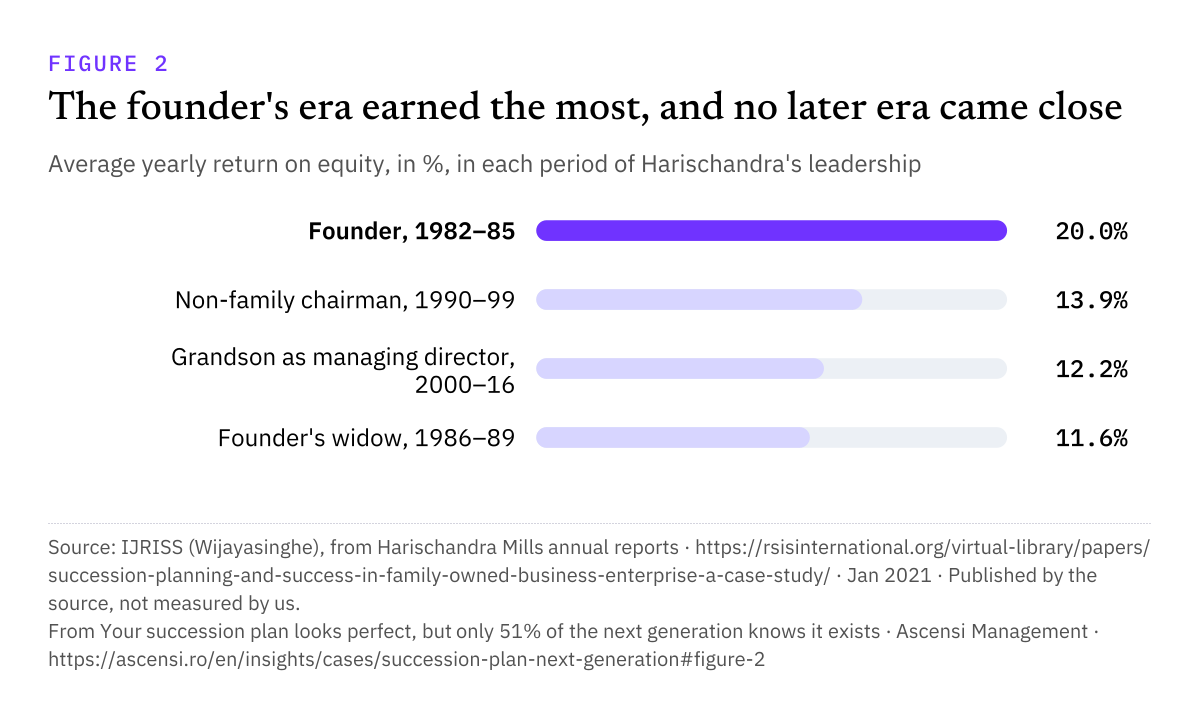
The founder's era earned the most, and no later era came close
Average yearly return on equity, in %, in each period of Harischandra's leadership
| Item | Value (%) |
|---|---|
| Founder, 1982–85 | 20.03 |
| Non-family chairman, 1990–99 | 13.87 |
| Grandson as managing director, 2000–16 | 12.24 |
| Founder's widow, 1986–89 | 11.64 |
Source: IJRISS (Wijayasinghe), from Harischandra Mills annual reports · Jan 2021 · Published by the source, not measured by us.
Use this figure
Cite
APA
Ascensi Management. (2026). The founder's era earned the most, and no later era came close [Figure 2]. In Your succession plan looks perfect, but only 51% of the next generation knows it exists. https://ascensi.ro/en/insights/cases/succession-plan-next-generation#figure-2 Data: IJRISS (Wijayasinghe), from Harischandra Mills annual reports, Jan 2021.
Chicago
Ascensi Management. “The founder's era earned the most, and no later era came close.” Figure 2 in Your succession plan looks perfect, but only 51% of the next generation knows it exists, 2026. https://ascensi.ro/en/insights/cases/succession-plan-next-generation#figure-2. Data: IJRISS (Wijayasinghe), from Harischandra Mills annual reports, Jan 2021.
Link to this figure
https://ascensi.ro/en/insights/cases/succession-plan-next-generation#figure-2
Download
Embed
<iframe src="https://ascensi.ro/embed/figure/caseStudy-succession-plan-next-generation-7Kc9sxXj3fGU" title="The founder's era earned the most, and no later era came close" width="640" height="420" loading="lazy"></iframe>
About this data
Each figure is the plain average of that period's yearly return on equity. The founder's period starts in 1982 because the paper's data starts there.
The paper gives the grandson's period an average of 12.13%; recalculated from its own table, 2000 to 2016 averages 12.24%. The paper also calls this period "the second generation", although the grandson is the third. The founder's and widow's averages (20.03% and 11.64%) match the table exactly.
A fall in the year a leader dies is a coincidence in time, not proof of cause. The paper's case rests on the pattern repeating across three handovers.
Cris-Tim: a handover made while the founder was still there
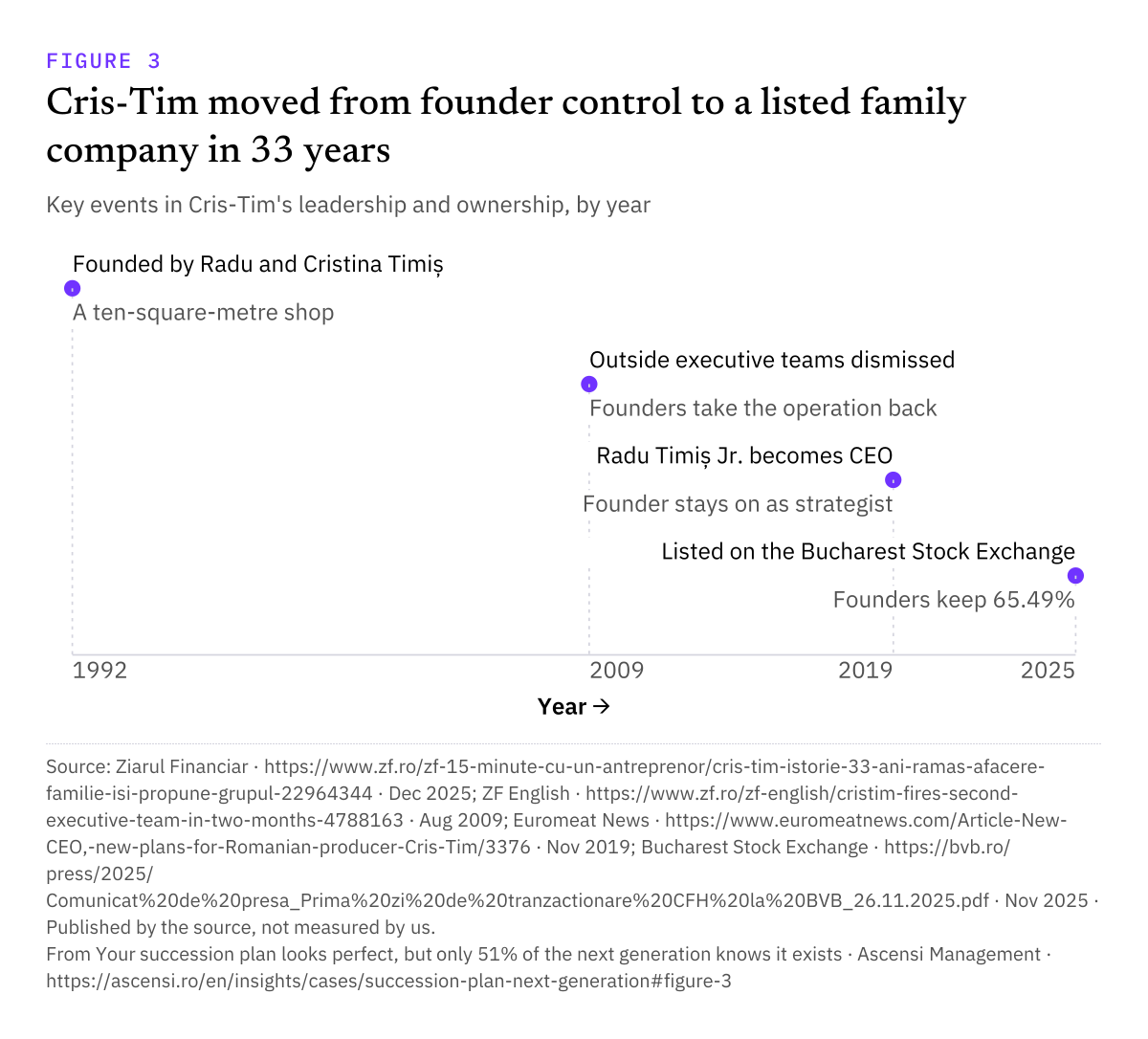
Radu and Cristina Timiș opened Cris-Tim in 1992 as a shop of ten square metres. It grew into the largest family-owned company in Romania's meat industry, making and distributing cured meats and ready meals. Its first attempt to bring in outside leaders failed. In 2009 the founder dismissed a second executive team within two months, saying "they did not share the vision, the ideas, the pace and style" of the company, and the two founders took the operation back.
The next handover went to the family, and it was made while the founder was alive and active. At the end of October 2019 Radu Timiș Jr. became chief executive, and his father stepped down to remain involved as a strategist. The sons had to earn the role. "If you don't earn trust, you can't get into the family business," Radu Timiș Jr. told a Revista Biz panel in November 2024, adding: "We operate purely on merit."
“I handed it over to the boys, aged 24 and 26, without knowing exactly what they were capable of.”
Radu Timiș, Co-founder, Cris-Tim
Translated from the original
Source: revistabiz.ro
Figure 3
Cris-Tim moved from founder control to a listed family company in 33 years
Key events in Cris-Tim's leadership and ownership, by year
| Item | Start (year) | Note |
|---|---|---|
| Founded by Radu and Cristina Timiș | 1,992 | A ten-square-metre shop |
| Outside executive teams dismissed | 2,009 | Founders take the operation back |
| Radu Timiș Jr. becomes CEO | 2,019 | Founder stays on as strategist |
| Listed on the Bucharest Stock Exchange | 2,025 | Founders keep 65.49% |
Source: Ziarul Financiar · Dec 2025; ZF English · Aug 2009; Euromeat News · Nov 2019; Bucharest Stock Exchange · Nov 2025 · Published by the source, not measured by us.
Use this figure
Cite
APA
Ascensi Management. (2026). Cris-Tim moved from founder control to a listed family company in 33 years [Figure 3]. In Your succession plan looks perfect, but only 51% of the next generation knows it exists. https://ascensi.ro/en/insights/cases/succession-plan-next-generation#figure-3 Data: Ziarul Financiar, Dec 2025; ZF English, Aug 2009; Euromeat News, Nov 2019; Bucharest Stock Exchange, Nov 2025.
Chicago
Ascensi Management. “Cris-Tim moved from founder control to a listed family company in 33 years.” Figure 3 in Your succession plan looks perfect, but only 51% of the next generation knows it exists, 2026. https://ascensi.ro/en/insights/cases/succession-plan-next-generation#figure-3. Data: Ziarul Financiar, Dec 2025; ZF English, Aug 2009; Euromeat News, Nov 2019; Bucharest Stock Exchange, Nov 2025.
Link to this figure
https://ascensi.ro/en/insights/cases/succession-plan-next-generation#figure-3
Download
Embed
<iframe src="https://ascensi.ro/embed/figure/caseStudy-succession-plan-next-generation-kZ8LYl2GEHq7" title="Cris-Tim moved from founder control to a listed family company in 33 years" width="640" height="420" loading="lazy"></iframe>
About this data
The Euromeat News article shows no year on the page; 2019 follows from its own text, which treats Anuga 2019 as past and 2020 as the year ahead.
1.12bn lei
2024 revenue
Cris-Tim's revenue in 2024, the last full year before its listing.
Source: Ziarul Financiar, 2025 · Dec 2025
454.35m lei
Listing raised
Value of Cris-Tim Family Holding's share offering, which started trading on 26 November 2025.
Source: Bucharest Stock Exchange, 2025 · Nov 2025
65.49%
Family stake kept
Share of Cris-Tim Family Holding the two founders still hold after the listing.
Source: Bucharest Stock Exchange, 2025 · Nov 2025
Cris-Tim publishes no measure tied to the handover itself, and its growth and listing have many causes. We do not claim the handover produced them. Whether the company has a written succession plan for the next generation is not public.
Insight
Harischandra's sharpest one-year fall in return on equity, 27 points, came in the year its founder died; another came when his widow died, and a third, of 12 points, in 2000, the year the grandson took over. Across 200 listed family companies, McKinsey finds that shareholder returns fall by 5.7 percentage points on average in the five years after a change of chief executive. Read together, these suggest a handover costs value by default, and the cost is highest when the handover is forced by a death rather than prepared. Cris-Tim took that risk earlier and on its own terms: the founder handed over while he could still watch the result and change course.
5.7points
Returns lost
Average fall in total shareholder return in the five years after a CEO change, across 200 listed family companies, 2000 to 2020.
Source: McKinsey, 2026 · Feb 2026
39%
Non-family CEO wins
Share of handovers to a non-family chief executive that created value, in the same McKinsey sample.
Source: McKinsey, 2026 · Feb 2026
29%
Family CEO wins
Share of handovers to a family chief executive that created value, in the same McKinsey sample.
Source: McKinsey, 2026 · Feb 2026
Romania: a first-generation economy that runs succession on trust
Most Romanian family companies have never passed from one generation to the next, as PwC Romania notes. In Central and Eastern Europe, 64% of family businesses are still led by their first generation, against 32% worldwide, according to PwC's 2024 CEE NextGen survey, citing its 2023 family business survey. PwC Romania's Mihai Anița put it plainly: Romania's family business ecosystem "is still young, having been founded less than 35 years ago" (Economedia, translated). An earlier EY barometer found that only one in five Romanian family firms with revenue above €1 million had reached the second generation. That survey dates from 2017, so treat the figure as directional.
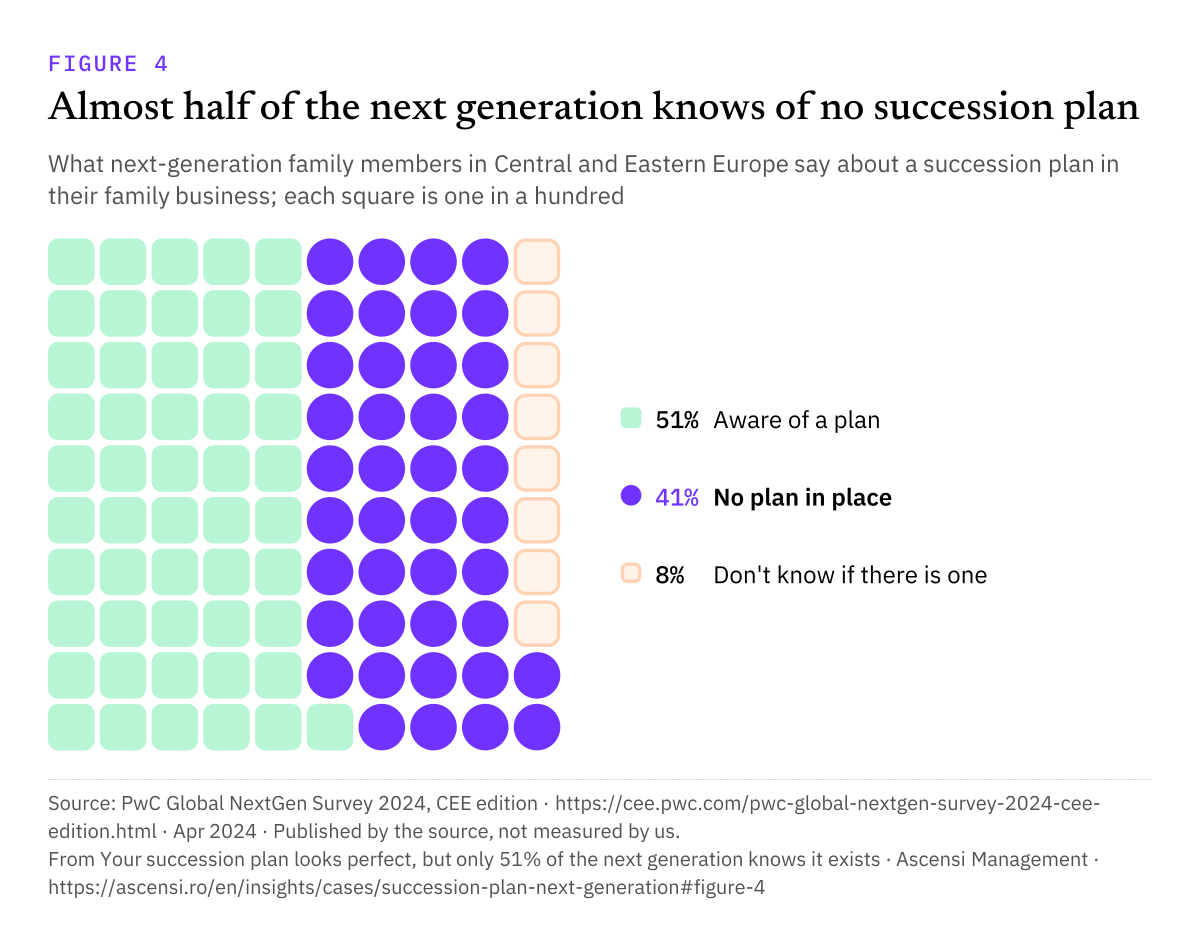
The headline number comes from the people who are meant to take over. Of 179 next-generation family members surveyed across the region, only 51% know a succession plan exists in their family's business. Another 41% say there is no plan, and 8% do not know. PwC adds that 15% were not involved in drawing up the plan.
Figure 4
Almost half of the next generation knows of no succession plan
What next-generation family members in Central and Eastern Europe say about a succession plan in their family business; each square is one in a hundred
Almost half of the next generation knows of no succession plan. Aware of a plan 51%, No plan in place 41%, Don't know if there is one 8%.
| Category | Value | Share | Cells |
|---|---|---|---|
| Aware of a plan | 51% | 51% | 51 |
| No plan in place | 41% | 41% | 41 |
| Don't know if there is one | 8% | 8% | 8 |
| Item | Value (%) |
|---|---|
| Aware of a plan | 51 |
| No plan in place | 41 |
| Don't know if there is one | 8 |
Source: PwC Global NextGen Survey 2024, CEE edition · Apr 2024 · Published by the source, not measured by us.
Use this figure
Cite
APA
Ascensi Management. (2026). Almost half of the next generation knows of no succession plan [Figure 4]. In Your succession plan looks perfect, but only 51% of the next generation knows it exists. https://ascensi.ro/en/insights/cases/succession-plan-next-generation#figure-4 Data: PwC Global NextGen Survey 2024, CEE edition, Apr 2024.
Chicago
Ascensi Management. “Almost half of the next generation knows of no succession plan.” Figure 4 in Your succession plan looks perfect, but only 51% of the next generation knows it exists, 2026. https://ascensi.ro/en/insights/cases/succession-plan-next-generation#figure-4. Data: PwC Global NextGen Survey 2024, CEE edition, Apr 2024.
Link to this figure
https://ascensi.ro/en/insights/cases/succession-plan-next-generation#figure-4
Download
Embed
<iframe src="https://ascensi.ro/embed/figure/caseStudy-succession-plan-next-generation-vNISHgmQ1804" title="Almost half of the next generation knows of no succession plan" width="640" height="420" loading="lazy"></iframe>
About this data
179 interviews in 11 CEE countries, Romania included, from November 2023 to January 2024. PwC does not publish a Romania-only figure; Economedia reports the sample as 180.
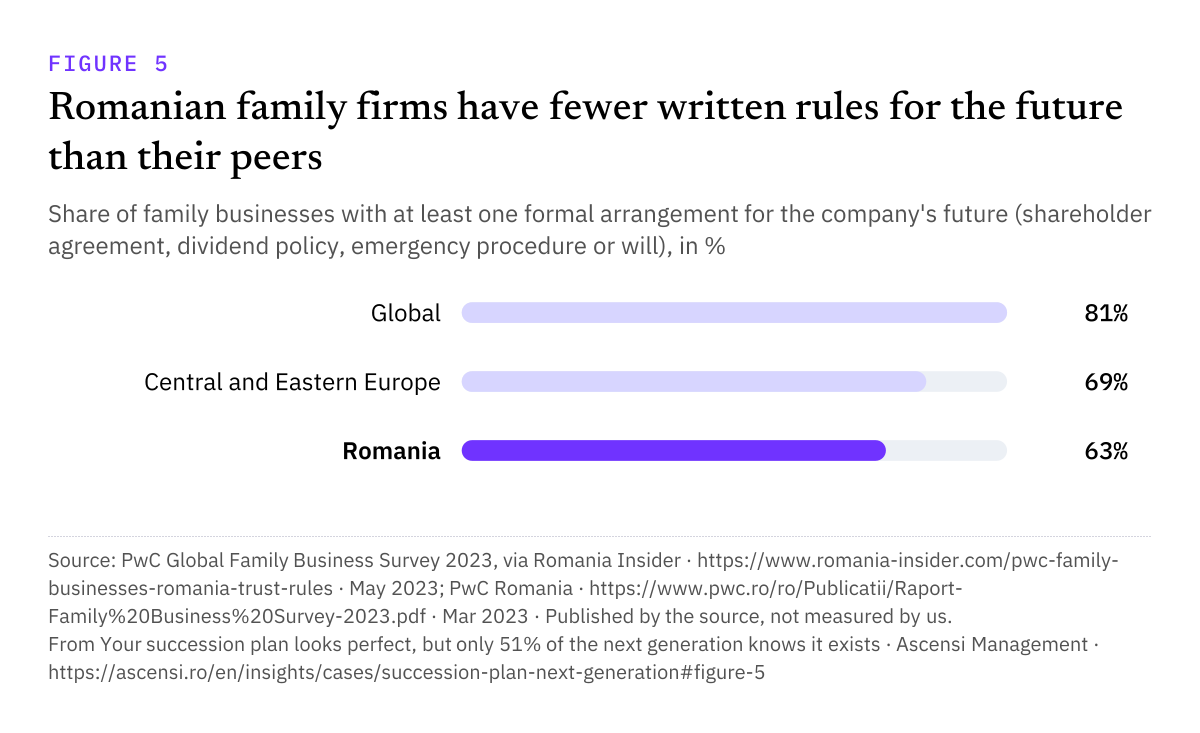
Where Romanian companies do plan, they plan on trust. PwC's 2023 survey concluded that succession in Romania rests "rather on the base of trust than formal rules" (Romania Insider). Romanian family firms have fewer written rules than their peers: 39% have a shareholder agreement and 12% a will, according to the PwC Romania report and its coverage.
Figure 5
Romanian family firms have fewer written rules for the future than their peers
Share of family businesses with at least one formal arrangement for the company's future (shareholder agreement, dividend policy, emergency procedure or will), in %
| Item | Value (%) |
|---|---|
| Global | 81 |
| Central and Eastern Europe | 69 |
| Romania | 63 |
Source: PwC Global Family Business Survey 2023, via Romania Insider · May 2023; PwC Romania · Mar 2023 · Published by the source, not measured by us.
Use this figure
Cite
APA
Ascensi Management. (2026). Romanian family firms have fewer written rules for the future than their peers [Figure 5]. In Your succession plan looks perfect, but only 51% of the next generation knows it exists. https://ascensi.ro/en/insights/cases/succession-plan-next-generation#figure-5 Data: PwC Global Family Business Survey 2023, via Romania Insider, May 2023; PwC Romania, Mar 2023.
Chicago
Ascensi Management. “Romanian family firms have fewer written rules for the future than their peers.” Figure 5 in Your succession plan looks perfect, but only 51% of the next generation knows it exists, 2026. https://ascensi.ro/en/insights/cases/succession-plan-next-generation#figure-5. Data: PwC Global Family Business Survey 2023, via Romania Insider, May 2023; PwC Romania, Mar 2023.
Link to this figure
https://ascensi.ro/en/insights/cases/succession-plan-next-generation#figure-5
Download
Embed
<iframe src="https://ascensi.ro/embed/figure/caseStudy-succession-plan-next-generation-gnoqqUIJeVSN" title="Romanian family firms have fewer written rules for the future than their peers" width="640" height="420" loading="lazy"></iframe>
About this data
PwC Romania's own report describes the Romanian figure as "two-thirds"; Romania Insider reports 63%. We chart the more precise figure.
The mistakes we see repeated
Put these sources side by side and the same six mistakes come up: in the PwC and EY surveys, in EY Romania's 2026 analysis in Capital, and in the two cases above. In the 2017 EY barometer the owners kept succession to themselves in 78% of Romanian firms, against 5% where the board held it; PwC found 30% of Romanian family boards are family-only.
The plan lives in the founder's head
Succession rests on trust rather than written rules, and only 12% of Romanian family firms have a will.
The successor is the last to know
Half of the next generation knows of no plan, and some who do were never asked to help shape it.
The handover waits for a crisis
A death or an illness forces the change, as it did twice at Harischandra, when nobody has been prepared.
The owner decides alone
No board or outside voice tests the choice, so it is never challenged before it is made.
Birth stands in for readiness
Being the founder's child is treated as a qualification instead of a starting point to be tested.
Tax and legal transfer come last
Shares, property and wills are left until the handover, when the estate is most exposed.
“Being born into a certain family does not give you the right to run a business.”
Corneliu Bodea, CEO, Adrem
Translated from the original
Source: revistabiz.ro
“It will be a long time before our children take over the running of the company. I remember that one of the managers reacted negatively to their arrival in the company.”
Felix Pătrășcanu, Co-founder, FAN Courier
Translated from the original
Source: wall-street.ro
The FAN Courier example points to a cost the surveys miss. When the next generation arrives without an explained plan, managers fill the silence with their own reading of what it means for them.
What a working plan looks like
The method is well documented, and it is the same whether the successor is a daughter, a son or a hired chief executive. The CIPD defines succession planning as "identifying and growing talent to fill business-critical positions in the future", and says transparency is key to how potential successors are judged. The University of California's workforce plan shows the larger cycle: set the direction, compare the skills you have with the skills you will need, act on the gaps, and review every year.
- Start from the strategy. Decide what the company must be able to do in five to ten years, then which leaders that will take (Korn Ferry).
- Name the critical roles. Rate each role on its impact, how scarce its skills are and how hard it would be to fill. This is the work of our Role-to-Value Alignment.
- Assess who could fill them, on evidence. Keep performance and potential separate and rate readiness: ready now, in one to two years, or in three to five. Aim for at least two named successors per critical role (Chronus). Korn Ferry's advice is "Don't default to favorites". This is the work of our Talent Mapping.
- Tell them, and agree a development plan. Confirm the person wants the role before naming them (Atlassian), and give them real responsibility to prove it, as Cris-Tim did.
- Hand over while you are still there. Set a date, keep the outgoing leader as an adviser with a defined role, and give the board the final review.
- Review it every year. Review the plan alongside the strategy, track how many critical roles have a ready successor, and update it after any resignation or reorganisation. Our HR Strategy Advisory ties these steps into one plan the board owns.
A plan the successor has never seen is a wish, not a plan.
Checklist
Signs your succession plan exists only on paper
List the critical roles
Write down the few roles the company could not run without for three months.
Rate readiness on evidence
Assess two candidates per role and give each a readiness date.
Tell them and the board
Agree development plans with the successors and a review date with the board.
Before and after: the cost of an unplanned handover
The case's measured result is a cost, not a gain. At Harischandra Mills, return on equity fell from 31.9% to 4.9% in the year the founder died, and from 19.03% to 7.14% in the year his widow died, both times with no one prepared to take over.
Both figures come from the company's annual reports as published in the IJRISS case study. We have not audited them.
Sources
- Systems for Success: a sustainability reference guide for M&S Food suppliers, Marks & Spencer, Nov 2020
- C. H. Wijayasinghe, Succession planning and success in family-owned business enterprise: a case study (Harischandra Mills PLC), IJRISS, Jan 2021
- Passing the baton: creating value through CEO succession at family businesses, McKinsey & Company, Feb 2026
- PwC Global NextGen Survey 2024, CEE edition, PwC, Apr 2024
- Raport PwC: peste două treimi dintre afacerile de familie din ECE sunt conduse de fondatori, Economedia, May 2024
- Family Business Survey 2023: raport România, PwC Romania, Mar 2023
- PwC survey: family businesses are developed based on trust rather than rules in Romania, Romania Insider, May 2023
- EY: una din cinci afaceri românești de familie de peste un milion de euro a trecut la a doua generație, Mediafax, Mar 2017
- EY România: România trebuie să adopte planuri de succesiune și structuri moderne de guvernanță, Capital, Mar 2026
- Cris-Tim, 33 de ani de istorie, a rămas afacere de familie, Ziarul Financiar, Dec 2025
- CrisTim fires second executive team in two months, ZF English, Aug 2009
- New CEO, new plans for Romanian producer Cris-Tim, Euromeat News, Nov 2019
- Prima zi de tranzacționare CFH la BVB, Bucharest Stock Exchange, Nov 2025
- Zilele Biz 2024: cum se consolidează dinastiile de business și rolul meritocrației, Revista Biz, Nov 2024
- Fondatorii FAN Courier: principalul asset al companiei este înțelegerea dintre noi trei, Wall-Street.ro, Mar 2026
- Succession planning factsheet, CIPD, Dec 2025
- Leadership succession explainer, Korn Ferry, May 2025
- A manager's ultimate guide to effective succession planning, Atlassian, Jan 2025
- Succession planning guide (page undated; accessed 1 November 2026), Chronus, Nov 2026
- Workforce plan, phases 1 to 5, 2019-20 to 2021-22, University of California Office of the President, Nov 2019
Related service
Growth hides its own cost until it starts to bite. Organizational Diagnosis, Role-to-Value Alignment, Talent Mapping and Talent Assessment, joined into one diagnosis of what your organization is losing, with the fixes ranked by what they are worth and how seamlessly they can be implemented.
Book a meeting about HR Strategy AdvisoryNewsletter