https://ascensi.ro/en/insights/boardroom-strategy-pivoting-hr-from-cost-center-to-profit-engine
Boardroom Strategy
Pivoting HR from Cost Center to Profit Engine
The efficiency era didn't shrink HR's job. It raised the price of getting hiring, management, and culture wrong — for the first time, put a number on all three.

Ascensi Management · 6 min read
The briefFor CEOs6 min read
- Before the next cut, ask how to architect the team for output, not how many people to remove.
- Before adding an AI tool to hiring or management, redesign the workflow around it.
- Track three numbers at board level: skill density, revenue per employee, and the turnover cost at risk in the departments that can least afford it.
On this page
If you treat HR as a cost, you'll always be looking for ways to shrink it. If you treat HR as a profit engine, you'll look for ways to supercharge it.
For decades, the CHRO was who you called to fire someone, update the handbook, or run the holiday party. To a CFO, that made HR a cost center — a necessary line item, not a lever.
The "efficiency era" changed the arithmetic. When AI can automate the routine work, the return on your workforce becomes the remaining competitive advantage. A company still running HR as back-office admin is leaking margin every quarter it waits.
The cost of gut-feeling hiring
Traditional hiring was a bet: a CV, a couple of interviews, a gut call, and hope. The two most commonly cited industry benchmarks for what a wrong bet costs:
- At the C-suite level, a bad hire is estimated to cost up to 200–213% of annual salary (Source: MyCulture, "Cost of Bad Hire").
- At the middle-management level, the estimate is 100–150% of annual salary (Source: SHRM, "The Cost of a Bad Hire Can Be Astronomical").
We chart both, with the Romanian replacement-cost data beside them, in Turnover Never Appears on the P&L.
From headcount to organization architecture
A cost-center CEO asks: how many people do I need to cut to hit my numbers? A profit-engine CEO asks: how should I architect my team to maximize output?
Strategic HR advisors are shifting from filling seats to designing the profile of talent that actually fits a company's strategy and culture — using the traits, working style, and digital fluency of a company's own top performers as the model, rather than a generic job description. Instead of hiring ten junior analysts, that can mean roadmapping three people who can direct AI tools well, and redirecting the rest of the budget into development for the core team already in place.
A concrete example of the mechanism at work is Unilever's AI-driven screening for entry-level and graduate hiring, built with HireVue and Pymetrics. By HireVue's own case-study figures, it cut the graduate hiring cycle by roughly 90%, saved over 50,000 hours of interview time and more than £1 million in annual cost, and increased candidate diversity.
Flagging a source discrepancy, not resolving it: HireVue's own published figure — corroborated by The Case Centre's case study and multiple independent write-ups — is 50,000 hours saved over 18 months. A Harvard Digital, Data, and Design case submission puts the figure at 100,000 hours, and a separate academic case analysis cites 70,000 person-hours. Neither of those higher figures traces back to a primary Unilever or HireVue source we could verify — so 50,000 is the number we're standing behind, and the others are noted here rather than quietly dropped.
What the AI data actually shows
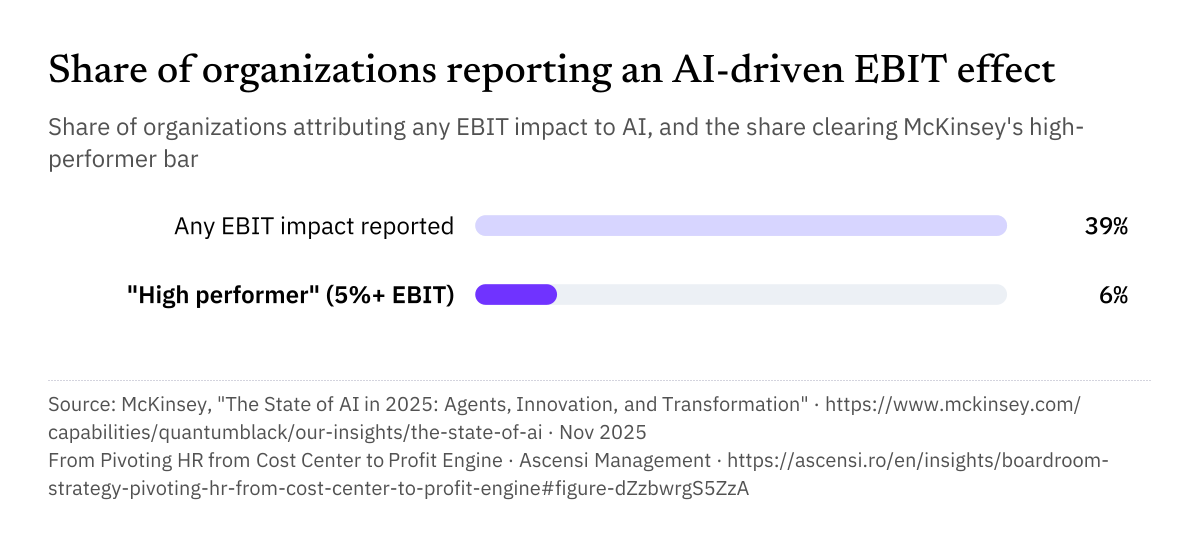
McKinsey's most recent global AI survey found that just 39% of organizations report any enterprise-level EBIT impact from AI at all, and most of that group puts the figure at under 5%. Only around 6% clear the bar of what McKinsey calls an "AI high performer" — 5% or more of EBIT attributable to AI.
Share of organizations reporting an AI-driven EBIT effect
Share of organizations attributing any EBIT impact to AI, and the share clearing McKinsey's high-performer bar
| Item | Value (%) |
|---|---|
| Any EBIT impact reported | 39 |
| "High performer" (5%+ EBIT) | 6 |
Source: McKinsey, "The State of AI in 2025: Agents, Innovation, and Transformation" · Nov 2025
Use this figure
Cite
APA
Ascensi Management. (2026). Share of organizations reporting an AI-driven EBIT effect [Figure]. In Pivoting HR from Cost Center to Profit Engine. https://ascensi.ro/en/insights/boardroom-strategy-pivoting-hr-from-cost-center-to-profit-engine#figure-dZzbwrgS5ZzA Data: McKinsey, "The State of AI in 2025: Agents, Innovation, and Transformation", Nov 2025.
Chicago
Ascensi Management. “Share of organizations reporting an AI-driven EBIT effect.” In Pivoting HR from Cost Center to Profit Engine, 2026. https://ascensi.ro/en/insights/boardroom-strategy-pivoting-hr-from-cost-center-to-profit-engine#figure-dZzbwrgS5ZzA. Data: McKinsey, "The State of AI in 2025: Agents, Innovation, and Transformation", Nov 2025.
Link to this figure
https://ascensi.ro/en/insights/boardroom-strategy-pivoting-hr-from-cost-center-to-profit-engine#figure-dZzbwrgS5ZzA
Download
Embed
<iframe src="https://ascensi.ro/embed/figure/3a81c126-1674-4cb1-a692-e145e78b7a82-dZzbwrgS5ZzA" title="Share of organizations reporting an AI-driven EBIT effect" width="640" height="420" loading="lazy"></iframe>
What separates that top 6% is how they use AI. McKinsey's own finding is that they're three times more likely to use AI for real transformation rather than layering it onto an unchanged process, and that workflow redesign is the single practice most correlated with EBIT impact — yet only a minority of AI-using companies have redesigned any workflow at all.
Insight
A company that bolts AI onto an unchanged hiring or management process is often the same company still absorbing bad-hire costs and running undertrained managers: both are symptoms of adding a tool without redesigning the workflow around it. "Organizational architecture" is the workflow redesign McKinsey's data names as the differentiator, applied to people decisions.
Gladiola Unzueta, Founder & CEO of MultiGla Strategies, argued in Chief Executive in August 2026 that new technology alone won't decide who leads: the companies that pull ahead are the ones that build strong cultures, invest in people and stay adaptable, and trust, leadership and execution will remain the true competitive advantages.
Culture as a retention referee
Replacing a high performer is expensive, and in a cost-focused market, culture gets dismissed as the "soft" metric. Gallup's global tracking found manager engagement fell five points — from 27% to 22% — in a single year, the sharpest drop the study has recorded. When the people running your teams disengage, their teams follow.
A toxic or stagnant culture shows up as quiet quitting and turnover most CEOs can feel but rarely have a figure for. A strategic HR advisor treats culture as a retention referee — protecting high performers from low performers, and protecting the company's institutional knowledge.
The strategic HR checklist for CEOs
| Metric | Why it matters for the P&L |
|---|---|
| Skill density | What share of staff has moved from legacy tasks to AI-integrated workflows — not just adopted a tool, but changed how the work gets done? |
| Revenue per employee | Is the technology investment making people more valuable, or just busier? |
| Predictive turnover cost | How much capital is at risk from talent flight in the departments that can least afford it? |
The bottom line
Your people determine how much your AI tools can actually deliver, and how much innovation your organization can produce.
Our HR Strategy Advisory turns hiring, management and culture into measured, funded parts of the P&L, reviewed before something breaks.
Cite this article
Ascensi Management (11 May 2026). Pivoting HR from Cost Center to Profit Engine. Ascensi Management Insights. https://ascensi.ro/en/insights/boardroom-strategy-pivoting-hr-from-cost-center-to-profit-engine
Cite this article with this credit; for a figure, credit the source shown under it.
Sources
- MyCulture, "Cost of Bad Hire", MyCulture, Mar 2026
- SHRM, "The Cost of a Bad Hire Can Be Astronomical", SHRM, May 2017
- HireVue-sourced Unilever case summary, HireVue, via aimyprofession case summary, May 2026
- The Case Centre, Unilever AI hiring case study, The Case Centre, May 2026
- Harvard D3, "HireVue: A face-scanning algorithm...", Harvard Digital, Data, and Design Institute, 12 Apr 2020
- ResearchGate, "Unilever's Practice on AI-based Recruitment", ResearchGate, May 2026
- McKinsey, "The State of AI in 2025: Agents, Innovation, and Transformation", McKinsey, Nov 2025
- Gallup, State of the Global Workplace, Gallup, Apr 2026
- Chief Executive, "In Final Stretch Of The Year, CEOs Push For Growth, Lean Into AI", Chief Executive, Aug 2026
Related service
HR Strategy Advisory
Growth hides its own cost until it starts to bite. Organizational Diagnosis, Role-to-Value Alignment, Talent Mapping and Talent Assessment, joined into one diagnosis of what your organization is losing, with the fixes ranked by what they are worth and how seamlessly they can be implemented.
Related articles
 Boardroom StrategyArticle
The AI Act Is Live. The Compliance Line Your Budget Is Missing.
9 min read · 9 Oct 2026 Available in English and Romanian
 Culture EconomicsArticle
The Pay-Rise Trap: 83% plan raises, only 34% expect growth
7 min read · 9 Oct 2026 Available in English and Romanian
 Talent EconomicsArticle
Turnover Never Appears on the P&L. That Is Why It Costs So Much.
5 min read · 9 Oct 2026 Available in English and Romanian
Newsletter